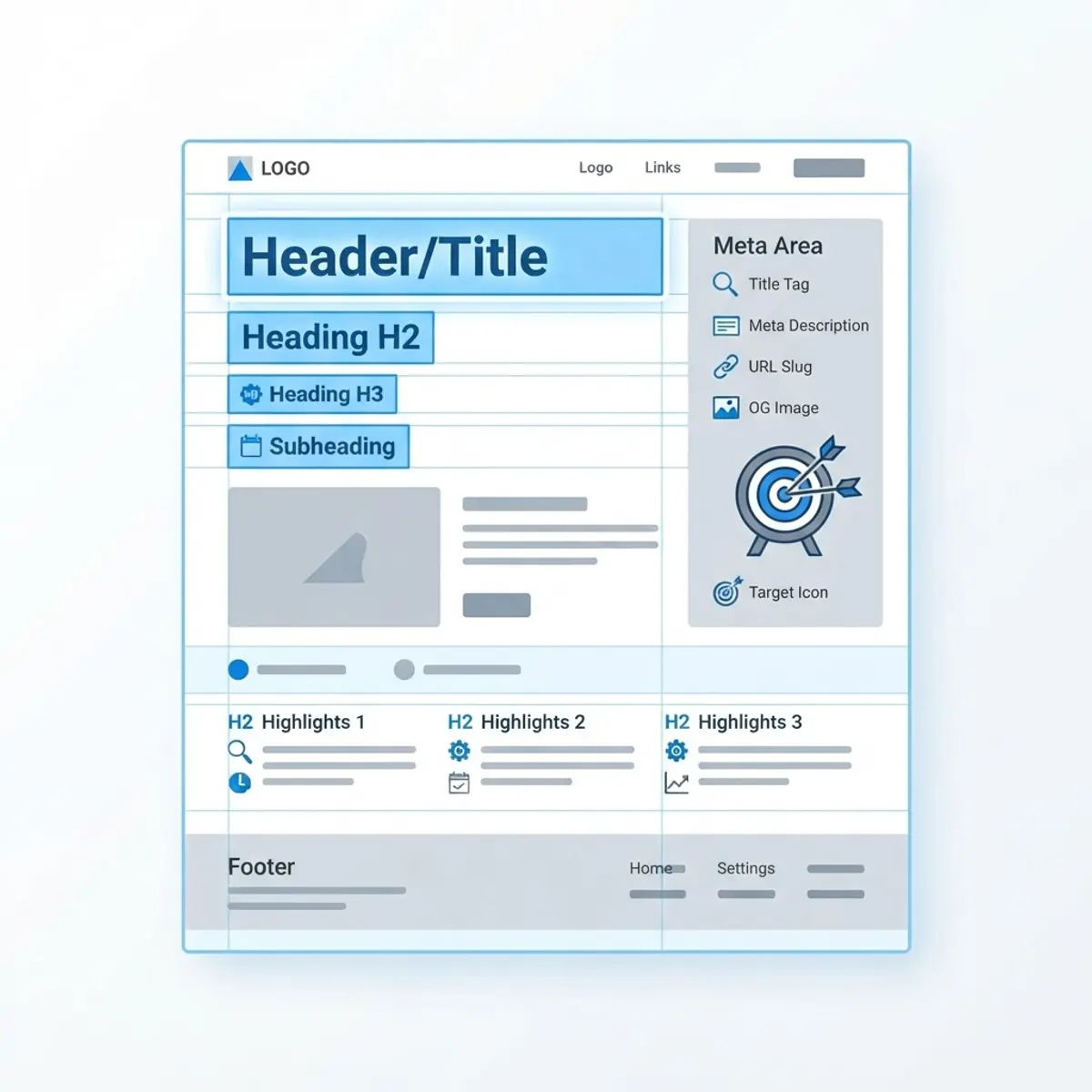
Most on-page advice is either too vague or drowning in jargon. What people actually want is a picture of the page with labels showing where each element belongs.
This visual guide to keyword targeting and on-page SEO does exactly that in words: it walks down a page from top to bottom, explaining what each zone does and how your target keyword should behave in it.
By the end you will have a repeatable checklist you can apply to any page, from a blog post to a product category.
What Is Keyword Targeting And On-Page SEO?
Keyword targeting is the decision about which query a specific page should win. On-page SEO is the execution: arranging title, headings, content, links and markup so the page clearly serves that query.
One page, one primary intent is the rule that prevents most on-page problems. When two pages chase the same query, both usually underperform.
Targeting is not about repetition. It is about clarity, so a reader and a crawler both understand within seconds what the page answers.
Who Needs This Guide?
Anyone publishing pages that need to rank, especially teams without a dedicated SEO reviewer.
- Content writers producing briefs into finished articles
- Small business owners managing their own website
- Developers building templates that must be SEO-friendly
- Marketing teams standardising quality across many authors
- Agencies delivering white label SEO content at volume
Key Zones Of An Optimised Page
The Title Tag And URL
Place the primary keyword near the front of the title and keep it under roughly 60 characters. The URL should be a short, hyphenated version of the same idea, with no dates or stop words.
The Opening 100 Words
State the answer immediately and include the target phrase naturally. Readers decide whether to stay in the first few seconds, and this zone signals topical focus strongly.
Headings And Subheadings
Use one H1 matching the page purpose, then H2s covering the logical subtopics a searcher expects. Two or three H2s should contain the keyword or a close variation, phrased like a real question.
Body Content, Media And Links
Support the topic with short paragraphs, lists, images with descriptive alt text, and internal links using contextual anchors. Aim for completeness rather than a word count target.
How To Apply It Page By Page
Work top to bottom so nothing gets skipped, and finish each page before starting the next.
- Choose one primary keyword and confirm no other page targets it.
- Identify the search intent: informational, comparison or transactional.
- Write the title tag with the keyword near the beginning.
- Set a clean slug matching the title.
- Answer the query in the first two sentences.
- Outline H2s from the questions searchers ask next.
- Add images with meaningful alt text and compress them.
- Insert two to four relevant internal links with descriptive anchors.
- Write a meta description of 150 to 160 characters that earns the click.
Benefits Of Structured On-Page Work
On-page optimisation is the highest-control part of SEO. You do not need anyone else's permission to improve it.
- Faster ranking gains than link building on most sites
- Higher click-through rates from clearer titles and descriptions
- Better user experience, which improves engagement signals
- Less cannibalisation because each page has one job
- Easier quality control across multiple writers
Potential Challenges
The common failures come from following the checklist mechanically instead of thinking about the reader.
- Forcing exact-match phrases until copy reads awkwardly
- Targeting queries the page cannot realistically satisfy
- Ignoring intent and writing a guide when buyers wanted prices
- Templates that generate duplicate titles across many pages
Best Practices And Tips
Keep the checklist short enough that people actually use it every time.
- Read the page aloud; if a keyword sounds forced, rephrase it
- Match the format of pages already ranking for your query
- Combine your on-page checklist with expert SEO optimization services when technical issues limit results
- Refresh top pages every six to twelve months with new information
Real-World Example
A software company had 25 blog posts loosely covering project management, with four of them targeting nearly identical queries. Rankings hovered between positions 15 and 30.
They assigned one primary keyword per page, merged three overlapping posts into a single detailed guide, rewrote titles with the keyword in front and added internal links from related articles. Two months later, the consolidated guide reached the top five and total organic sessions rose by 45 percent without a single new post.
Why It Matters
On-page structure is how you communicate purpose. Get it wrong and even excellent writing gets misread by both people and algorithms.
A visual guide to keyword targeting and on-page SEO matters because clarity scales. Once your team sees the page as labelled zones, quality stops depending on individual talent.
Frequently Asked Questions
How many times should a keyword appear?
Enough to read naturally, roughly one percent of the text. Placement in title, intro, headings and conclusion matters more than frequency.
Can one page target several keywords?
Yes, if they share the same intent. Distinct intents need separate pages.
Do meta descriptions affect rankings?
Not directly, but they influence click-through rate, which affects how much traffic your ranking actually delivers.
How long should an optimised page be?
As long as needed to fully answer the query. Match the depth of competing pages rather than chasing arbitrary counts.
Conclusion
Treat every page as labelled zones: title, intro, headings, body, media and links, each reinforcing one clear intent.
Apply the checklist consistently and results follow. For hands-on help optimising your key pages, see our on-page SEO services.