Every booking that arrives through an online travel agency costs a luxury property between 15% and 25% in commission. On a $900-a-night suite booked for four nights, that is up to $900 handed to a middleman for a guest who might have booked directly — if the property's own website had given them a reason to. Multiply that across a year of occupancy and the case for a direct-booking-first website stops being a design conversation and becomes a revenue strategy.
Yet most luxury hotel and resort websites still underperform, and the failures follow a pattern: gorgeous photography wrapped around a clunky third-party booking widget, pages that take six seconds to load on the mobile devices where most travel research happens, and no compelling answer to the guest's silent question — why should I book here instead of on the OTA where I found you? Having designed and rebuilt booking-focused sites for hospitality brands, our team has learned which practices actually move the direct-booking needle. This guide covers all of them.
Table of Contents
- Why direct bookings should shape every design decision
- Visual storytelling that sells the stay
- Designing the booking journey
- Mobile experience: where luxury sites lose the most
- Trust signals and the direct-booking value proposition
- Performance and SEO foundations
- Frequently asked questions
- Final thoughts
Why Direct Bookings Should Shape Every Design Decision
A luxury hospitality website has one commercial job: convert the guest's interest into a reservation made on your domain, not on Booking.com or Expedia. Everything else — brand storytelling, dining pages, spa menus — exists in service of that job. This sounds obvious, but audit most five-star property websites and you will find the booking path treated as an appendage: a "Book Now" button that opens an unstyled third-party engine on a different subdomain, breaking the visual spell the rest of the site worked so hard to cast.
The economics justify treating the website as a product, not a brochure. Direct bookings carry no commission, give the property ownership of the guest relationship and data, and open the door to pre-arrival upsells — room upgrades, dining reservations, spa appointments — that OTA bookings rarely capture. Industry studies consistently show that guests who book direct also tend to spend more on property and are more likely to return.
Design for that outcome from the first wireframe. Every page should carry a persistent, elegant path to check availability. The booking engine should feel like part of the site, not an exit from it. And the value of booking direct — better rate, flexible cancellation, perks — should be articulated before the guest ever compares your price against an OTA listing.
Visual Storytelling That Sells the Stay
Luxury is bought with emotion and justified with details, and photography carries most of that emotional load. The best-performing luxury hospitality sites lead with full-bleed imagery that answers a single question: what will it feel like to be there? Golden-hour terrace shots, texture close-ups of linens and marble, candid moments of experience — these outperform sterile wide-angle room inventories every time. Video, used with restraint, deepens the effect: a slow twelve-second loop of curtains moving in a sea breeze communicates more atmosphere than three paragraphs of copy.
Restraint is the discipline that separates luxury design from merely expensive-looking design. Generous white space, a muted palette drawn from the property itself, no more than two typefaces, and typography that breathes. Copy should be short, sensory, and specific — "a private plunge pool overlooking the caldera" beats "world-class amenities" in every test we have run. Cut anything that sounds like it could describe any hotel anywhere.
Structure matters as much as beauty. Each room category deserves its own page with a full gallery, honest floor-plan details, and its own availability check — not a row in a comparison table. Experience pages (dining, spa, excursions) should each end with a soft path back to booking. This architecture serves guests and search engines alike, giving each page a clear intent. Getting this foundation right is core website design work, and it pays compounding returns across every campaign the property ever runs.
Designing the Booking Journey
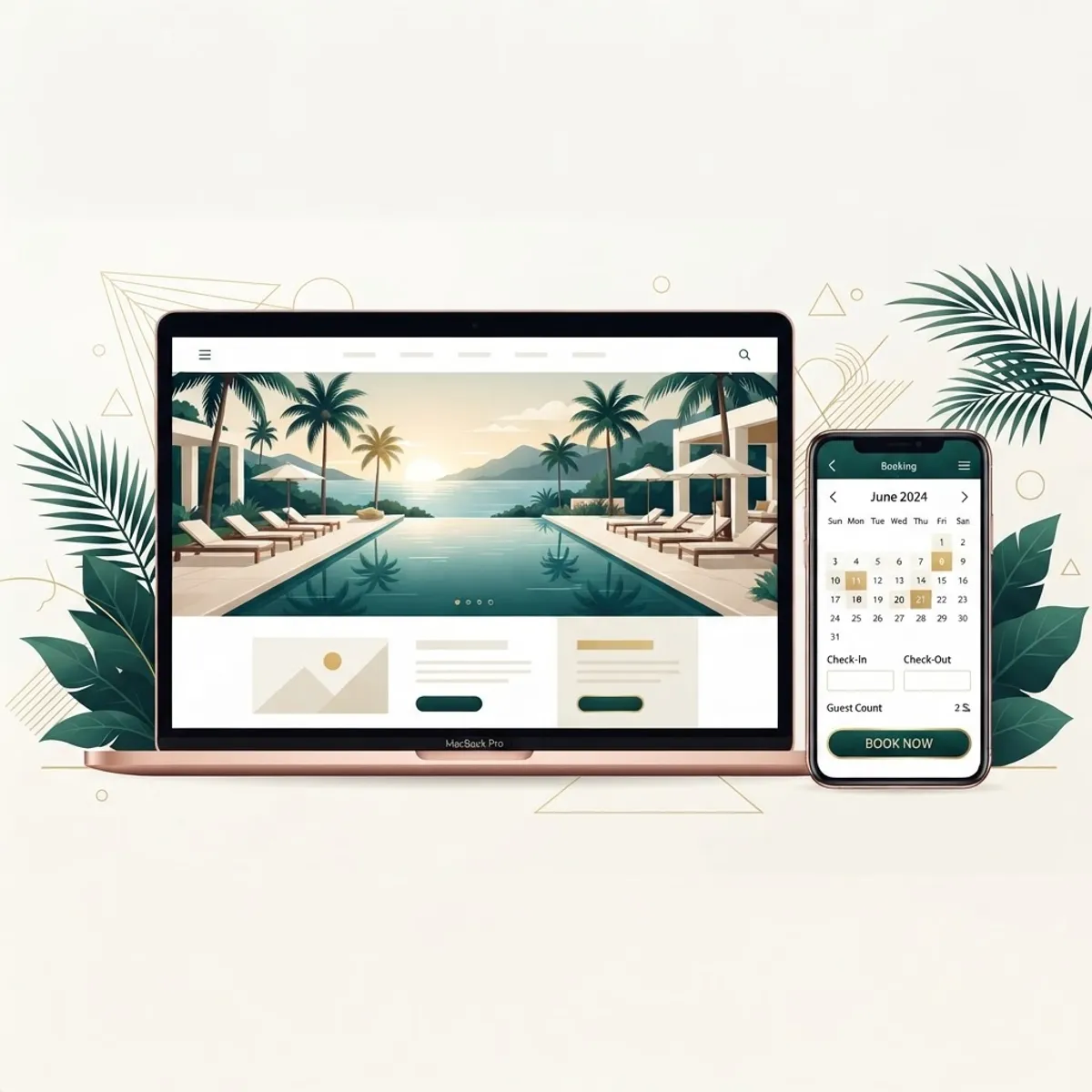
The booking journey is where luxury websites most often betray their brand. A guest glides through cinematic pages, clicks "Reserve," and lands in a generic booking engine with mismatched fonts, a different header, and a form that looks borrowed from a budget airline. Continuity is the first best practice: the booking flow must inherit the site's typography, palette, and tone, whether through a deeply customized engine or a custom front end talking to the booking API.
Reduce the journey's friction at every step. The availability widget should be reachable from any page in one interaction, with dates and guests as the only required inputs. Calendar UIs must show rates inline so guests are not forced through repeated searches. Room selection should preserve the imagery and storytelling — small thumbnails and abbreviation-riddled rate names ("DLX KNG GV") erode confidence precisely when the guest is deciding. And the final form should ask only for what is necessary: every additional field measurably increases abandonment.
For properties whose booking engines cannot be adequately styled, a custom integration layer is often worth the investment — a bespoke availability and room-selection experience built on the engine's API, handing off only at final payment. This is specialized back-end web development paired with careful front-end web development, and for high-ADR properties the arithmetic is friendly: shifting even five bookings a month from OTA to direct typically covers the build cost within the first year.
Mobile Experience: Where Luxury Sites Lose the Most
Travel research is overwhelmingly mobile — guests browse destinations from sofas, compare properties in taxis, and increasingly complete high-value bookings from their phones. Yet luxury hospitality sites are among the worst mobile performers on the web, because the very assets that make them beautiful — massive imagery, video backgrounds, elaborate animations — are exactly what cripples a phone on hotel-lobby Wi-Fi or cellular data.
The technical fixes are unglamorous and essential. Serve responsive images in modern formats (WebP or AVIF) sized to the actual viewport, not the desktop original. Lazy-load everything below the first screen. Replace autoplaying background video on mobile with a high-quality still. Aim for a Largest Contentful Paint under 2.5 seconds on a mid-range phone over 4G — a threshold most luxury sites miss by multiples.
Mobile UX deserves equal attention. The availability check must be thumb-reachable and persistent, galleries must swipe natively, and the booking form must respect mobile conventions: correct keyboard types per field, autofill support, and payment options like Apple Pay and Google Pay that collapse checkout from minutes to seconds. A guest who has to pinch-zoom a date picker at 11pm will simply open the OTA app instead — and cost you 20% of the booking.
Trust Signals and the Direct-Booking Value Proposition
Guests default to OTAs partly from habit and partly from trust: familiar checkout, visible reviews, a sense of recourse if something goes wrong. A direct-booking website has to earn that trust deliberately. Rate confidence comes first — a clear best-rate guarantee, stated plainly beside the booking widget, neutralizes the fear of overpaying. Direct-booking perks should be specific and tangible: complimentary breakfast, room upgrade on availability, flexible cancellation, early check-in. Vague loyalty-program gestures do not move behavior; a concrete perk does.
Social proof needs to live on the site, not just on third-party platforms. Curated guest reviews with names and stay dates, awards that carry real weight, and press mentions from credible publications all reduce perceived risk. So do operational trust signals: visible security badges at payment, transparent tax and fee disclosure before the final step, and a real phone number answered by a human — for a five-figure villa booking, many guests still want to hear a voice before they commit.
Finally, capture the guests who are not ready to book. A tasteful newsletter signup offering something of genuine value — a destination guide, seasonal offers — turns anonymous browsers into a marketable audience. Paired with a disciplined email marketing program for pre-arrival upsells and post-stay rebooking, the website becomes the hub of a guest lifecycle rather than a one-shot conversion page.
Performance and SEO Foundations
None of the above matters if guests never find the site, or find it and wait six seconds for it to render. Luxury hospitality SEO starts with structure: every room category, restaurant, and experience on its own indexable page with descriptive titles and meta descriptions written for humans. Schema markup — Hotel, Room, Offer, and FAQ types — helps search engines present rich results with rates, amenities, and review stars, which materially improves click-through against OTA listings that dominate branded searches.
Content is the long game that compounds. Destination guides, seasonal itineraries, and honest local recommendations attract travelers during the dreaming phase, before they have chosen a property — and every one of those pages can end with a soft path to availability. This editorial layer is where a capable content writing partner earns their fee, because generic travel filler neither ranks nor persuades. Consistency matters more than volume: two genuinely useful pieces a month outperform a launch burst that goes silent by summer.
On the technical side, treat Core Web Vitals as a standing commitment, not a launch checkbox. Image-heavy luxury sites drift toward bloat with every new gallery and campaign page, so schedule quarterly performance audits alongside routine website maintenance and support. Google's own research has long shown that as mobile load time goes from one to three seconds, bounce probability rises by roughly a third — and in this segment, every bounce has a three-comma nightly rate attached to it.
Frequently Asked Questions
1. How much do OTAs charge hotels in commission? Online travel agencies typically charge 15% to 25% commission per booking, with luxury and independent properties often at the higher end. On high average daily rates, a single redirected booking can represent hundreds of dollars in recovered margin, which is why direct-booking website investment pays back quickly.
2. What matters most in a luxury hotel website design? Three things dominate: emotional visual storytelling that sells the experience, a booking journey that feels seamless and on-brand from first click to confirmation, and mobile performance fast enough that guests researching on phones never feel friction. Weakness in any one of the three undermines the other two.
3. How do I get guests to book direct instead of through Booking.com? Give them concrete, immediate reasons: a best-rate guarantee displayed beside the booking widget, tangible perks like complimentary breakfast or flexible cancellation for direct bookers, and a booking flow that is genuinely as easy as the OTA's. Then make sure your branded search results and site speed do not push them back to the OTA out of convenience.
4. Should a luxury hotel build a custom booking engine? Usually not from scratch — payments, inventory, and channel management are solved problems. The high-ROI middle path is a custom-designed booking front end built on your existing engine's API, so the guest experience stays fully on-brand while the engine handles the transactional plumbing underneath.
5. How important is mobile for luxury travel bookings? Critical and growing. Most travel research happens on mobile, and an increasing share of high-value bookings complete there. Because luxury sites are typically heavy with imagery and video, they suffer disproportionately on mobile networks — making performance optimization one of the highest-leverage investments a property can make.
6. What is a good conversion rate for a hotel website? Hotel website conversion rates commonly fall between 1.5% and 2.5% of sessions, with well-optimized direct-booking sites for desirable properties exceeding that. More useful than the absolute number is your trend: track look-to-book ratio monthly and treat every checkout-step drop-off as a design problem to solve.
7. How long does a luxury hospitality website redesign take? A full redesign with custom booking integration typically runs three to six months depending on photography production, content development, and the complexity of the booking engine work. Phased approaches — launching the marketing site first, then the enhanced booking layer — get revenue improvements live sooner.
8. Does blog content actually help hotels get bookings? Yes, when it targets the dreaming and planning phases of travel. Destination guides and genuinely useful local content attract travelers before they have chosen a property, build the topical authority that lifts rankings for commercial terms, and feed the email list that drives repeat direct bookings.
Final Thoughts
Luxury hospitality web design in 2026 is a revenue discipline wearing an aesthetic costume. The properties winning the direct-booking battle are not necessarily the ones with the most beautiful sites — they are the ones whose beauty is engineered around a fast, seamless, trustworthy path to reservation, on mobile as much as desktop, with clear reasons to book direct stated before the guest ever opens a comparison tab.
If your property's look-to-book ratio suggests the website is leaking bookings to OTAs, the gap is usually identifiable within a single audit: booking-flow friction, mobile performance, or a missing value proposition. Our team builds direct-booking-first hospitality websites end to end — strategy, design, booking engine integration, and the ongoing optimization that keeps them converting. Share your current site and booking data, and we will show you precisely where the commission recovery is hiding.