Traditional SEO reports rankings. SEO performance marketing reports pipeline. The shift sounds small, but it changes what you work on, how you prioritise and how leadership judges the channel.
Instead of chasing every keyword you can rank for, performance-driven SEO targets the queries most likely to produce revenue, then treats each page like a campaign asset with a conversion job to do.
This guide covers how that model works in practice: the metrics that matter, the workflow, the tooling, the common failure points, and a realistic example of what the numbers look like when it works.
What Is SEO Performance Marketing?
SEO performance marketing is the practice of running organic search with the accountability standards of paid media. Every initiative has a hypothesis, a target metric, a measurement window and an expected return.
The defining trait is attribution: work is prioritised by expected revenue impact rather than search volume. A keyword with 200 monthly searches and clear purchase intent often beats one with 20,000 informational searches, and a performance approach makes that trade-off explicit.
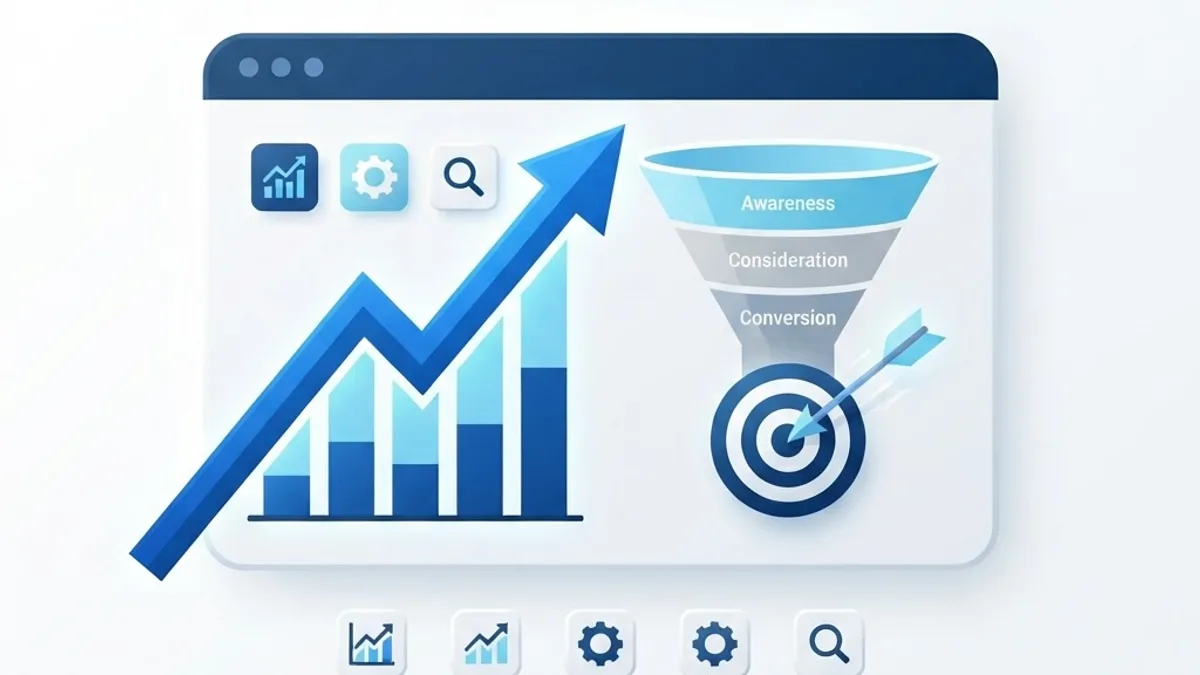
Practically, it merges three disciplines. SEO supplies demand capture and technical health. Conversion rate optimisation turns visitors into leads. Analytics ties both to closed revenue so budget decisions rest on evidence.
Who Needs This Approach?
Any team that must justify organic investment against paid alternatives, or that has traffic but not enough revenue to show for it.
- Companies with rising paid CAC looking for a channel with better long-term unit economics.
- Ecommerce brands tracking revenue per session and category-level margin.
- B2B teams needing organic to contribute qualified pipeline, not just downloads.
- Marketplaces and lead-gen businesses where volume and lead quality both matter.
- Agencies reporting to clients who care about cost per acquisition, not position tracking screenshots.
Key Features of SEO Performance Marketing
Revenue-Weighted Keyword Prioritisation
Keywords get scored on intent, competitive difficulty, funnel stage and the value of the product they lead to. High-intent commercial terms and comparison queries usually rise to the top even at low volume.
Conversion-Optimised Landing Pages
Ranking is half the job. Each page needs clear structure, proof, and a decisive next step. Teams often A/B test closing sections and buttons using proven prompts such as those in this list of powerful call to action phrases, since a small lift in click-through compounds across every ranking page.
SERP Click-Through Optimisation
You can gain traffic without moving a single position by improving how your listing reads. Titles and descriptions are effectively ad copy, and the trust-focused approach explained in this guide to writing a meta description for a counseling website transfers well to any high-consideration industry.
Full-Funnel Measurement
Server-side analytics, CRM integration, offline conversion imports and cohort reporting so organic gets credit for deals it influenced weeks earlier.
How to Run SEO as a Performance Channel
Treat it as a repeating loop rather than a project with an end date.
- Set the target metric. Pick one primary outcome: revenue, qualified leads, or cost per acquisition from organic.
- Baseline everything. Current organic sessions, conversion rate by template, revenue per session and top landing pages.
- Build a revenue-weighted keyword map. Score opportunities and assign each to a specific page or a new one.
- Fix technical blockers. Indexing, rendering, speed and internal linking, because no optimisation survives a crawl problem.
- Ship in prioritised sprints. Refresh existing high-potential pages first; they respond fastest.
- Run conversion tests. Headlines, proof placement, form length and CTA wording on your top ten landing pages.
- Report on business outcomes. Pipeline, revenue and CAC by cluster, with rankings as a supporting diagnostic only.
- Reinvest. Double down on clusters that convert, retire ones that do not after a fair testing window.
Benefits of a Performance-Led SEO Model
The advantage is decision quality. You stop arguing about tactics and start comparing returns.
- Lower blended acquisition cost as organic conversions grow without proportional spend.
- Compounding returns, since optimised pages keep producing after the work stops.
- Clear budget justification with revenue attribution executives actually accept.
- Faster wins from conversion and CTR improvements that do not require new rankings.
- Better paid performance too, because landing page and messaging learnings transfer directly.
Potential Challenges
Performance SEO is harder to run than traditional SEO because measurement is genuinely difficult.
- Attribution complexity in long B2B cycles with many touchpoints and self-directed research.
- Lag between work and results, which clashes with monthly reporting expectations.
- Zero-click and AI summaries reducing clicks on informational queries.
- Over-indexing on bottom-funnel terms, which caps growth once you exhaust them.
Best Practices and Tips
A few habits separate teams that scale organic revenue from teams that plateau.
- Report leading indicators monthly and revenue impact quarterly so nobody panics in week six.
- Refresh before you publish; updating a page already ranking on page two is usually the cheapest win available.
- Keep an 80/20 split between bottom-funnel capture and top-funnel demand creation to avoid a growth ceiling.
- Track revenue per session by template, not just by page, so you know which page types deserve more investment.
Real-World Example
A B2B logistics platform had 45,000 monthly organic sessions and 30 demos a month. Traffic came almost entirely from broad informational guides that ranked well but converted at 0.06 percent.
The team rebuilt priorities around 40 commercial queries such as software comparisons, integration searches and specific route-planning problems. They refreshed 18 existing pages, added proof and pricing transparency, rewrote titles and descriptions across the top 50 URLs, and tested closing CTAs. Total traffic actually fell to 38,000 sessions, yet monthly demos rose to 94 and organic-attributed pipeline nearly tripled. Fewer visitors, far better ones.
Why SEO Performance Marketing Matters Now
Paid channels keep getting more expensive while search results get more crowded with ads, AI answers and rich features. Traffic-only SEO is increasingly fragile in that environment.
Tying organic search to revenue protects the channel two ways: it directs effort toward queries with commercial intent that are less likely to be answered by a summary box, and it gives you the data to defend the budget when leadership asks hard questions.
Frequently Asked Questions
How is this different from regular SEO?
Regular SEO optimises for visibility, measured in rankings and sessions. SEO performance marketing optimises for revenue, using conversion rate, cost per acquisition and pipeline as the primary success metrics.
How do you attribute revenue to organic search?
Combine analytics with CRM data using UTM-tagged internal journeys, first and last touch views, self-reported attribution on forms, and incrementality checks such as comparing cohorts before and after a cluster launch.
How long until SEO delivers measurable performance?
Conversion and CTR improvements can show within weeks. New ranking-driven growth typically needs three to six months, with compounding gains after that.
Can small businesses use this approach?
Yes, and often more easily, because sales cycles are shorter and attribution is simpler. Start with the handful of pages that already produce enquiries and improve those before expanding.
Conclusion
SEO performance marketing turns organic search from a visibility exercise into an accountable growth channel. Prioritise by revenue potential, fix the technical foundation, optimise pages for conversion, and report on outcomes rather than positions.
Begin with a baseline audit of conversion rate by landing page — the gaps you find are usually worth more than any new keyword. Review your top ten organic landing pages this week and test one improvement on each.