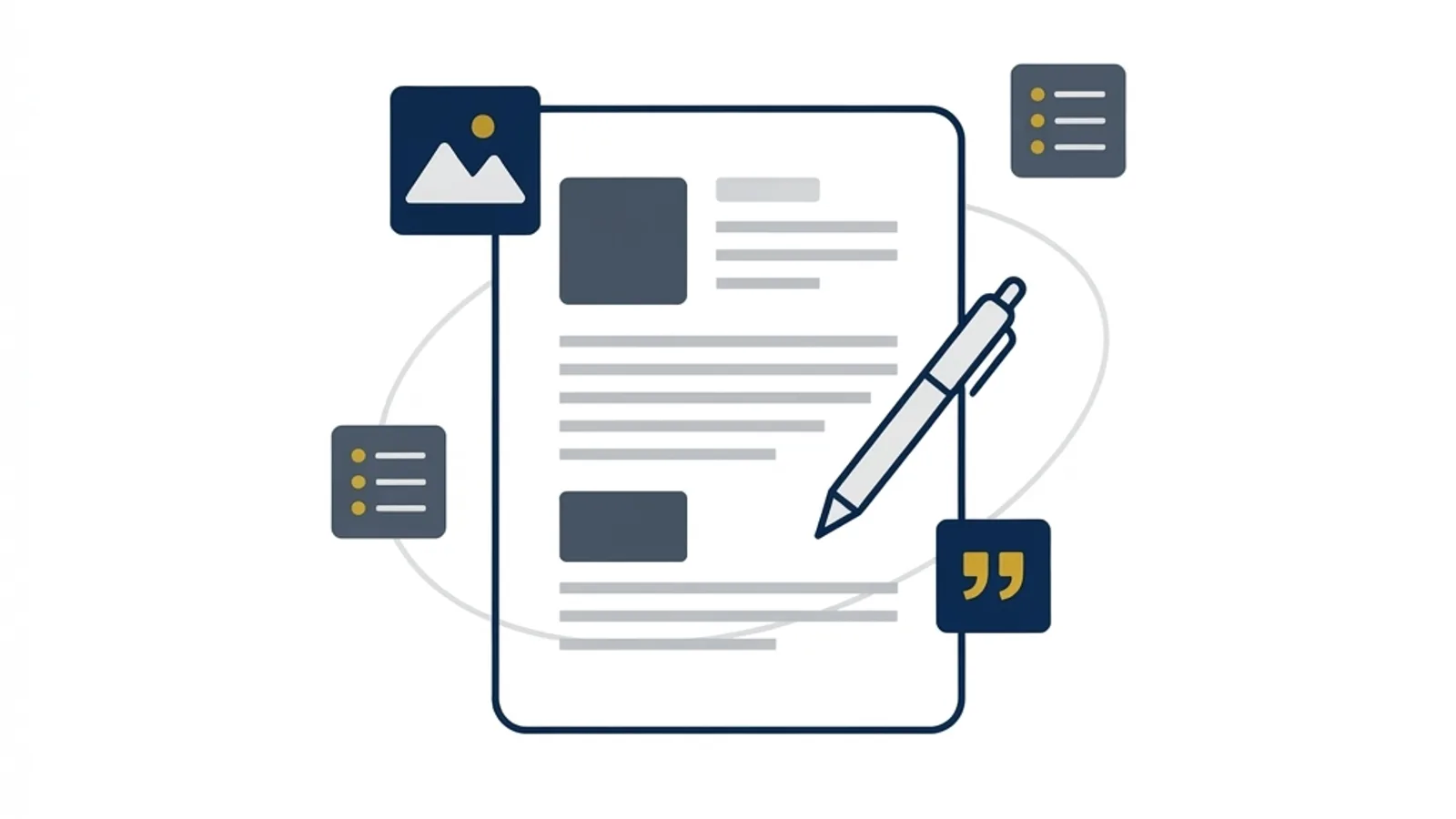
If you've ever been asked to "improve the content" on a page and weren't entirely sure what that included, you're not alone. The word gets used so loosely that it can mean anything from a blog post to a product photo.
So let's answer it properly: what is content in writing, what does it actually consist of, and what separates content that works from words that just fill space?
This guide gives you a practical definition, the main types you'll encounter, the structural elements that make content readable, and a repeatable process for producing it.
What Is Content in Writing?
In writing, content refers to the substance being communicated — the information, ideas, arguments, and details that a reader takes away. It's distinct from style (how it's expressed) and format (where it appears).
In a digital marketing context, "content" also refers to the assets themselves: articles, guides, emails, scripts, landing pages, and documentation. Both meanings are valid, and they overlap in practice.
The most useful working definition is this: content is the value a reader receives in exchange for their attention. If there's no takeaway, there's no content — just text.
Who Creates and Uses Content?
Content creation isn't limited to marketers. Almost every role that communicates in writing produces it, often without calling it that.
- Marketers and content writers producing blogs, guides, and campaign assets.
- Product and technical teams writing documentation, release notes, and help articles.
- Sales teams creating proposals, one-pagers, and follow-up sequences.
- Educators and researchers developing course material and explanatory writing.
- Business owners writing service descriptions, newsletters, and customer updates.
Key Elements of Content in Writing
Substance and Accuracy
The core of any content is verifiable, useful information. Claims should be checkable, examples should be real, and gaps should be acknowledged rather than papered over with confident-sounding vagueness.
Structure
Structure is how readers navigate substance. Headings, subheadings, lists, short paragraphs, and logical order do more for comprehension than clever phrasing. Poorly structured content fails even when the ideas are excellent.
Audience Alignment
Content only works when calibrated to the reader's existing knowledge. The same topic needs different depth for a beginner than for a specialist. Assuming too much loses people; explaining too much bores them.
Supporting Media
Words rarely work alone. Diagrams, screenshots, charts, and illustrations carry information that prose handles awkwardly. Pairing text with a clear visual infographic often doubles retention of a complex process.
How to Create Effective Content: Step by Step
Understanding what content is matters less than being able to produce good content consistently. Here's a process that works across formats.
- Define the single question your content answers. If you can't state it in one sentence, narrow it.
- Identify your reader and what they already know, so you can pitch depth correctly.
- Research thoroughly — primary sources, real data, and firsthand experience beat summarizing other summaries.
- Outline before drafting. Decide the sequence of ideas and what each section must accomplish.
- Draft quickly without editing. Momentum produces better raw material than perfectionism.
- Edit ruthlessly for clarity, cutting anything that doesn't serve the reader's takeaway.
- Add supporting media, format for scannability, and verify every factual claim.
- Publish, then review performance and revise based on how people actually engage.
Benefits of Understanding Content Properly
A clear definition changes how you plan, brief, and evaluate writing across a whole organization.
- Better briefs. You can specify the takeaway instead of just a word count.
- Sharper editing. Substance-first review catches empty writing that reads smoothly.
- Improved search performance, since modern ranking systems reward genuine informational value.
- Higher engagement — readers stay when they're learning something.
- Reusability, because well-structured content adapts easily to other channels.
Potential Challenges
Producing real content is harder than producing text, and the difficulties are consistent across teams.
- Confusing volume with value. More words often means less clarity.
- Research shortcuts. Rewriting competitors' articles produces content with nothing new to offer.
- Unclear audience. Writing for "everyone" produces content that serves no one.
- Neglecting maintenance. Content decays; facts, prices, and screenshots go stale.
Best Practices and Tips
Small habits produce large improvements in content quality over time.
- Write the takeaway sentence before you write anything else, then make sure the piece delivers it.
- Use concrete numbers and named examples instead of qualifiers like "many" or "significantly."
- Read drafts aloud — awkward sentences and filler become obvious immediately.
- Schedule quarterly reviews of your highest-traffic pieces so accuracy keeps up with reality.
Real-World Example
A software company published a 2,500-word article titled around a common integration problem. It read professionally and included every relevant keyword, but it never actually showed how to solve the problem — it just described the problem at length. Time on page was under 40 seconds.
The rewrite cut the length to 1,400 words and replaced the generic explanation with a numbered walkthrough, three annotated screenshots, and a short troubleshooting table drawn from real support tickets. Same topic, same keyword, but now with actual content. Average time on page tripled, and the article started earning links from community forums because it genuinely answered the question.
Why It Matters
Search engines and AI answer systems have gotten sophisticated at detecting whether a page adds information or merely restates what already exists. Pages built on original substance get cited and ranked; pages built on paraphrase increasingly disappear.
Understanding what is content in writing is therefore practical, not academic. It tells you where to spend effort: on research, examples, and clarity rather than on word count and keyword placement.
Frequently Asked Questions
What is the difference between content and copy?
Content informs and educates; copy persuades and sells. A how-to guide is content. A landing page headline is copy. Most effective websites use both deliberately.
Does content only mean written text?
No. Content includes video, audio, images, and interactive material. In writing specifically, it refers to the informational substance of the text plus any media that supports it.
How long should content be?
Long enough to fully answer the question and no longer. Depth should be dictated by the topic's complexity, not by an arbitrary target. Padding a short answer damages both readability and rankings.
Can AI write good content?
AI drafts fast but doesn't have firsthand experience or proprietary data, which is exactly what makes content valuable. The strongest results come from human expertise supported by thoughtful AI tooling and careful editing.
Conclusion
Content in writing is the substance — the information and insight a reader genuinely gains. Style and format matter, but they're packaging. If there's no takeaway inside, no amount of polish will make a page perform.
Focus on real research, clear structure, and honest specifics, and your writing will serve both readers and search engines. If you'd like help building a consistent process, explore professional content writing services and start with your highest-value pages.