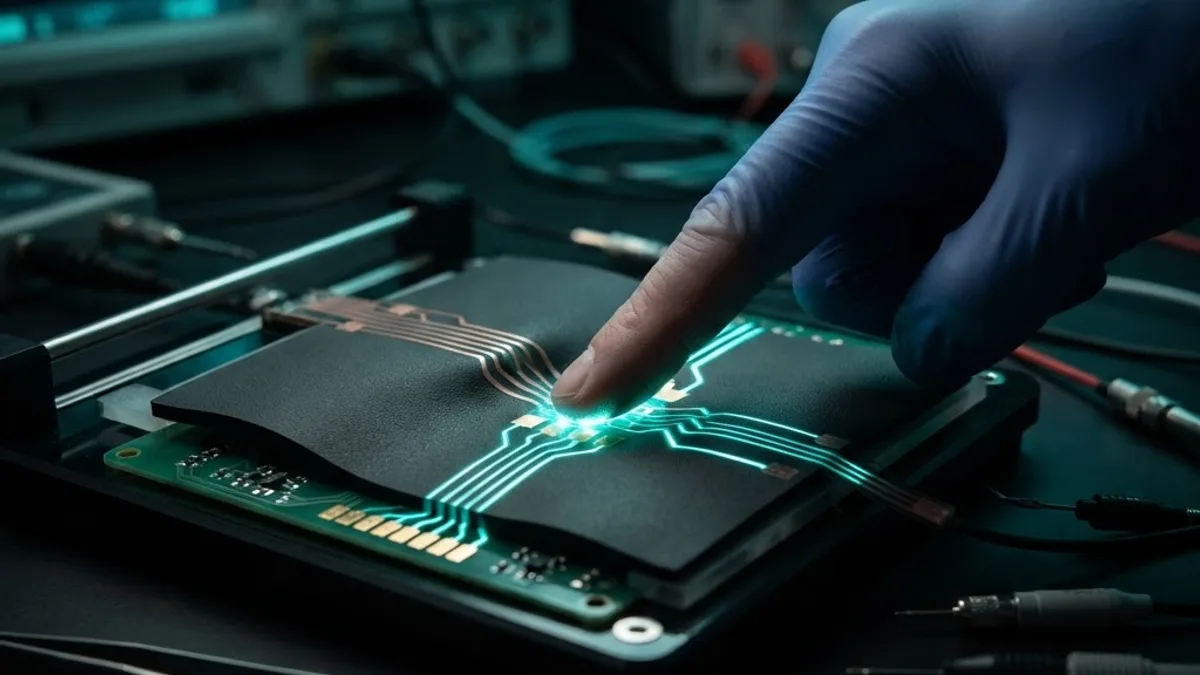
Imagine a material that behaves like a perfect insulator when left alone but starts conducting electricity the moment you press on it — and does so smoothly, in proportion to how hard you squeeze. That is exactly what Quantum Tunneling Composite (QTC) does, and it has quietly found its way into everything from touch sensors and robotics to wearable electronics and specialized switches.
This guide explains what Quantum Tunneling Composite is, the physics that makes it work, how it is manufactured, and where engineers put it to use. Whether you are a student, a hobbyist, or a product designer, you will leave with a clear, practical understanding of this fascinating material.
Table of Contents
- What Quantum Tunneling Composite is
- The physics: how quantum tunneling works
- How QTC is made
- Key properties and behavior
- Real-world applications
- Advantages and limitations
- QTC vs other pressure sensors
- Frequently asked questions
- Final thoughts
What Quantum Tunneling Composite Is
Quantum Tunneling Composite is a variable-resistance material made by blending metallic conductive particles into a flexible, non-conductive polymer such as silicone rubber. In its resting state, the metal particles are held apart by the insulating polymer, so almost no current flows — the material acts as an insulator.
When you apply pressure, the particles are pushed closer together. At a certain point they are near enough that electrons can "tunnel" across the tiny gaps between them, allowing current to flow. The harder you press, the more conductive the material becomes and the lower its electrical resistance. Release the pressure, and it returns to being an insulator.
The result is a material whose resistance can change by many orders of magnitude in response to force, bending, or compression — a property that makes it extraordinarily useful for sensing.
The Physics: How Quantum Tunneling Works
The name comes from quantum tunneling, a genuine quantum-mechanical phenomenon. In classical physics, an electron cannot cross a barrier unless it has enough energy to go over it. In quantum mechanics, particles behave as waves of probability, and there is a small but real chance that an electron will appear on the other side of a thin barrier even without enough energy to climb over it. This is tunneling.
In QTC, the insulating polymer between the conductive particles is the barrier. When the particles are far apart, the barrier is too wide for meaningful tunneling, so the material does not conduct. When pressure narrows the gaps, the probability of electrons tunneling across rises sharply, and current begins to flow.
What makes the effect so useful is its sensitivity: tunneling probability depends exponentially on the width of the gap. That is why a small change in pressure can produce a large, smooth change in conductivity, giving QTC its signature responsiveness.
How QTC Is Made
The composite is produced by dispersing sharp, spiky metallic particles — often nickel — throughout an elastomer binder. The spiky shape of the particles is important: the fine points concentrate the electric field and make tunneling more effective at close range.
QTC is manufactured in several forms to suit different applications. Common formats include thin sheets, coated pills or pellets, and printable inks. Each format is tuned for a particular use, from flat sensor pads to flexible, wearable surfaces. Because the base polymer is flexible, the finished material can bend, stretch, and conform to curved surfaces while retaining its pressure-sensing behavior.
Key Properties and Behavior
The defining property of QTC is its enormous dynamic range. Its resistance can shift from hundreds of megaohms when relaxed to just a few ohms under firm pressure. This wide swing makes it easy to detect even subtle force changes.
The response is also continuous rather than binary. Unlike a simple on/off switch, QTC provides a graded signal — light touches produce small changes and firm presses produce large ones. This makes it ideal for applications that need to measure how much force is applied, not just whether contact happened.
QTC responds to more than direct pressure. Bending, twisting, and stretching can all bring the particles closer together, which is why it works well in flexible and wearable designs. It is also durable, sealing well against moisture and handling repeated compression cycles.
Real-World Applications
QTC shows up in a surprising number of products. In consumer electronics, it enables pressure-sensitive buttons and touch controls that respond to how firmly you press. In robotics, it gives machines a sense of touch, allowing grippers to detect contact and adjust their grip force.
Wearable technology uses QTC in flexible sensors embedded in clothing, gloves, and fitness devices to track movement and pressure. The medical field applies it in pressure-mapping systems that help prevent bedsores and in assistive devices for people with limited mobility. It also appears in specialized switches for harsh or explosive environments, because it can be fully sealed and has no moving contacts to spark.
For product teams turning sensing hardware into complete, connected products, pairing the hardware with solid web applications and reliable back-end web development is often what makes the data genuinely useful to end users.
Advantages and Limitations
The advantages are compelling: QTC is flexible, durable, sealable, and offers a wide, continuous range of response. It has no moving parts, which improves reliability, and it can be shaped into sheets, pills, or inks for diverse designs.
It also has limitations. QTC is best for detecting relative changes in pressure rather than precise absolute measurements, because its response can drift and is affected by temperature. It is generally not as linear or as precisely calibrated as dedicated load cells. For applications that need laboratory-grade force measurement, other sensor types may be more appropriate.
QTC vs Other Pressure Sensors
Compared with force-sensing resistors (FSRs), QTC typically offers a wider resistance range and better flexibility, though FSRs are often cheaper and adequate for simple designs. Compared with capacitive touch sensors, QTC directly measures force rather than proximity, making it better suited to applications that need genuine pressure sensitivity.
Compared with strain gauges and load cells, QTC trades precision for flexibility and cost. Load cells win when you need exact, repeatable force values; QTC wins when you need a rugged, bendable, low-cost way to sense that pressure is being applied and roughly how much.
How QTC Compares to Other Sensing Materials
QTC is not the only pressure-sensing material available, and understanding its place among the alternatives helps engineers choose wisely. Force-sensitive resistors, for example, also change resistance under pressure, but QTC typically offers a far wider dynamic range and can be produced in more flexible, conformable formats.
Capacitive sensors, common in touchscreens, detect proximity and light touch extremely well but are less suited to measuring firm, graded force. Piezoelectric sensors generate a charge when deformed and excel at detecting dynamic changes and vibration, but they are less effective at reporting sustained, static pressure. QTC sits in a useful niche: it handles a broad range of static and dynamic force, bends and stretches with the surface it is on, and seals well against the environment. For applications that need durable, flexible, wide-range force sensing, it is often the most practical option.
Working With QTC in Your Own Projects
Hobbyists and engineers can experiment with QTC without specialized equipment. In its pill or sheet form, it can be wired into a simple circuit where its changing resistance is read by a microcontroller, letting you build touch-sensitive buttons, pressure pads, or bend sensors. Because the resistance change is large and smooth, even basic analog inputs can capture a useful signal.
A few practical tips improve results. Keep the electrical contacts clean and consistently placed, since contact quality affects readings. Account for some drift and hysteresis by calibrating in software rather than relying on a fixed threshold. And design your mechanical mounting so pressure is applied evenly across the material, which produces a more reliable and repeatable response. With a little tuning, QTC becomes an accessible and rewarding material for interactive electronics.
Frequently Asked Questions
Is Quantum Tunneling Composite actually quantum? Yes — its conductivity relies on quantum tunneling, a real quantum-mechanical effect where electrons cross a thin barrier between conductive particles.
What is QTC made of? It is a blend of spiky metallic particles, often nickel, dispersed in a flexible insulating polymer such as silicone rubber.
What happens when you press QTC? Pressure pushes the conductive particles closer together, dramatically increasing the chance of electron tunneling and lowering the material resistance so current can flow.
Can QTC measure exact force? It is better at detecting relative pressure changes than precise absolute values. For lab-grade accuracy, a load cell is a better choice.
Where is QTC used? In pressure-sensitive buttons, robotic touch sensors, wearables, medical pressure mapping, and sealed switches for hazardous environments.
Is QTC durable? Yes. It has no moving parts, can be sealed against moisture, and tolerates many compression cycles, making it reliable in demanding conditions.
Final Thoughts
Quantum Tunneling Composite is a beautiful example of quantum physics doing practical work in everyday devices. By turning the abstract idea of electron tunneling into a simple "squeeze to conduct" behavior, QTC gives engineers a flexible, durable, and versatile way to add pressure sensing to almost anything.
It is not the right tool for every job — precision force measurement still belongs to load cells — but for flexible, rugged, cost-effective sensing, few materials are as elegant. As wearables, robotics, and smart products continue to grow, expect to see QTC in even more places.
Building a product around advanced sensing? Explore how expert front-end web development can turn raw sensor data into intuitive, beautiful interfaces your users will love.