Hiring a web designer is one of those decisions that looks simple until you're actually doing it. Suddenly you're comparing freelancers to agencies, deciphering wildly different quotes, and trying to judge whether a beautiful portfolio will translate into results for your business. Choose well and you get a partner who elevates your brand and drives growth. Choose poorly and you get missed deadlines, a site that doesn't convert, and the painful cost of doing it all again.
The good news is that the difference between a great hire and a regrettable one usually comes down to a handful of factors you can evaluate up front. This guide walks through exactly what to consider when hiring a web designer, so you can make a confident decision and avoid the most common — and most expensive — mistakes.
Table of Contents
- Freelancer, agency, or in-house?
- Evaluating the portfolio properly
- The skills and services you actually need
- Process and communication
- Understanding pricing and value
- Red flags to watch for
- Questions to ask before hiring
- Frequently asked questions
- Final thoughts
Freelancer, Agency, or In-House?
Your first decision is the type of designer to hire, and each option has clear trade-offs. A freelancer is often the most affordable and flexible choice, ideal for smaller projects, but capacity is limited and you're relying on one person's range of skills and availability.
An agency brings a full team — designers, developers, content specialists, and marketers — which suits larger or more complex projects that need multiple disciplines. You pay more, but you get depth, redundancy, and the ability to handle everything from website design to ongoing digital marketing under one roof.
Hiring in-house makes sense only if you have continuous, long-term design needs that justify a full-time salary. For most businesses building or refreshing a site, the real choice is between a freelancer for focused work and an agency for comprehensive, multi-disciplinary projects.
Evaluating the Portfolio Properly
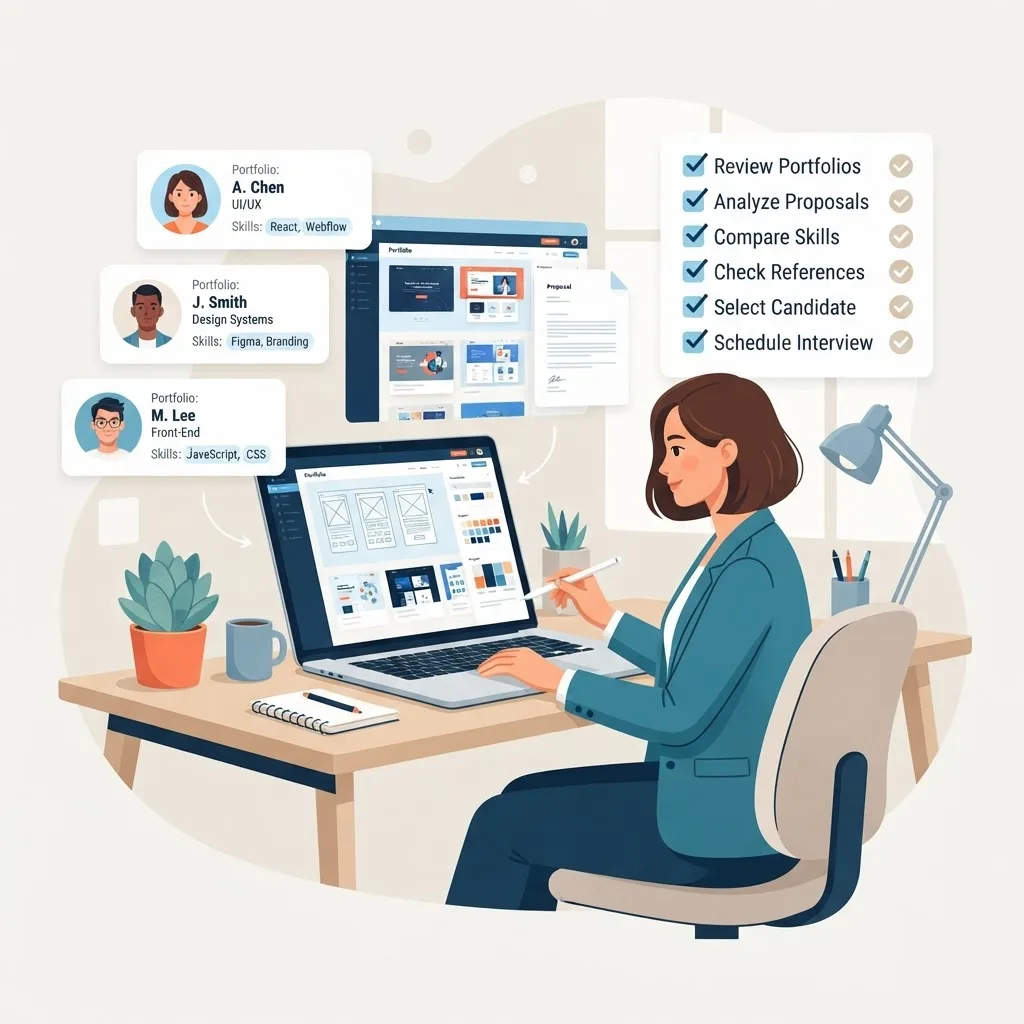
A portfolio is the single best predictor of what you'll get, but only if you review it the right way. Don't just admire the visuals — interrogate them. Look for work in your industry or for similar goals, and check whether the sites are actually functional by visiting them live rather than trusting polished mockups.
Test those live sites yourself. Are they fast? Do they work well on your phone? Is the navigation clear? A designer's real skill shows in whether their sites perform, not just how they look in a case study image. Pay attention to variety too — a portfolio full of identical templates suggests limited range.
Finally, read the story behind the work. Strong designers explain the problem, their approach, and the results. Case studies that mention measurable outcomes — more leads, higher conversions, faster load times — demonstrate that the designer thinks about business impact, not just aesthetics.
The Skills and Services You Actually Need
Before comparing candidates, get clear on what your project truly requires. A simple brochure site has very different needs from an e-commerce store or a custom web application. Matching the designer's strengths to your needs prevents both overpaying and underdelivering.
Consider the full scope. Do you need just visual design, or also development? If development is involved, which platform fits — a flexible WordPress development build for easy editing, or a modern framework like Next JS for a high-performance app? Do you also need content, SEO, or branding support?
Be honest about ongoing needs too. If you'll require regular updates and improvements, a designer or agency offering website maintenance and support will serve you better than one who disappears after launch. Clarity here helps you evaluate candidates against the right criteria.
Process and Communication
How a designer works is nearly as important as what they produce. A clear, structured process — discovery, wireframes, design, development, testing, launch — signals professionalism and reduces the risk of chaos. Ask candidates to walk you through their process and how they handle revisions and feedback.
Communication makes or breaks projects. You want someone responsive, who explains decisions in plain language, sets clear expectations, and keeps you informed at each stage. If a designer is hard to reach or vague during the sales conversation, that rarely improves once you've paid.
Also clarify how feedback and changes are managed. How many revision rounds are included? How are new requests scoped and priced? A designer who sets these boundaries clearly at the start is protecting both of you from misunderstandings later.
Understanding Pricing and Value
Price is where many hiring decisions go wrong, in both directions. The cheapest option often becomes the most expensive once you factor in rework, missed goals, and lost time. The priciest isn't automatically the best either. The goal is value: the return the site generates relative to what you invest.
Understand what's included in any quote. Does it cover strategy, content, revisions, testing, and post-launch support, or just a basic build? A low number that excludes essentials isn't really cheaper. Ask for a detailed breakdown so you can compare like with like.
Think about the site as an investment, not a cost. A well-built website that consistently generates leads or sales pays for itself many times over. When you frame the decision around the revenue the site should produce, the right budget usually becomes clear.
Red Flags to Watch For
Certain warning signs reliably predict trouble. Be cautious of anyone who guarantees specific rankings or overnight results — reputable professionals promise quality work and sound strategy, not impossible outcomes. Vague answers about process, timelines, or what's included are another red flag.
Watch for poor communication during the sales stage, reluctance to share references or live examples, and portfolios that only show mockups rather than working sites. A designer who dismisses accessibility, mobile experience, or SEO as unimportant is revealing a shallow understanding of modern web design.
Finally, be wary of anyone who doesn't ask about your business and goals. A designer who jumps straight to talking about visuals without understanding what you're trying to achieve is likely to produce something pretty but ineffective.
Questions to Ask Before Hiring
A few well-chosen questions reveal a great deal. Ask, "Can you show me live sites you've built for businesses like mine, and what results they achieved?" This tests both relevance and outcome focus. Ask, "What's your process, and how do you handle revisions and feedback?" to gauge structure and flexibility.
Ask, "Who owns the site and its content when the project is done?" to avoid nasty surprises about hosting lock-in or licensing. Ask, "What happens after launch — do you offer support and updates?" to understand the long-term relationship.
Finally, ask, "How do you approach mobile, accessibility, and SEO?" Their answer instantly reveals whether they build modern, future-proof sites or cut corners. Pair a strong designer with supporting services like content writing and you have a recipe for a site that performs long after launch.
How to Structure the Engagement for Success
Once you've chosen a designer, how you set up the working relationship has a big impact on the outcome. A few structural choices protect both sides and keep the project on track.
Start with a paid discovery or a small pilot. Rather than committing your entire budget on day one, consider a smaller first phase — a strategy session, a homepage design, or an audit. This lets you experience how the designer works before the stakes are high, and it's a low-risk way to confirm you've made the right choice.
Agree on milestones and payment stages. Break the project into clear phases with defined deliverables and payments tied to them. This keeps momentum honest and gives you natural checkpoints to review progress instead of waiting anxiously for a single big reveal.
Define what 'done' means for each stage. Ambiguity is the enemy of design projects. Specify what approval looks like at each milestone so neither side is surprised when it's time to move on.
Keep a single point of contact on your side. Feedback from a committee, delivered piecemeal, is one of the fastest ways to derail a project. Consolidate your input so the designer receives clear, consistent direction.
Plan for the relationship beyond launch. The best websites evolve. Agreeing up front on how updates, support, and future improvements will be handled — ideally through structured website maintenance and support — turns a one-off build into a lasting partnership that keeps paying off.
Frequently Asked Questions
1. How much should I expect to pay a web designer? Costs range widely, from a few hundred dollars for a very simple freelance site to tens of thousands for a complex agency build. Focus on the value and return rather than the raw price, and make sure quotes include everything you need.
2. Should I hire a freelancer or an agency? A freelancer suits smaller, focused projects on a tighter budget, while an agency fits larger or multi-disciplinary work that needs design, development, content, and marketing together. Match the choice to your project's complexity.
3. How do I check if a designer is any good? Review their live portfolio sites for speed, mobile experience, and clarity, read their case studies for measurable results, and check references or reviews. How they communicate during your first conversations is also very telling.
4. What should be included in a web design contract? A clear contract should cover scope, deliverables, timeline, revision rounds, pricing, ownership of the site and content, and post-launch support. Getting these in writing prevents disputes later.
5. How long does it take to hire and complete a project? Hiring can take a few weeks of research and conversations, and the project itself ranges from a few weeks to several months depending on scope. Rushing the hire often costs more time later.
6. Do I own my website after it's built? You should, but confirm it explicitly. Clarify ownership of the design, content, domain, and hosting up front so you're never locked into a provider against your will.
7. What's the biggest mistake people make when hiring a web designer? Choosing purely on price, or judging only on looks. The best hires balance quality, process, communication, and a genuine understanding of your business goals.
Final Thoughts
Hiring a web designer is a significant decision, but it doesn't have to be a gamble. By clarifying your needs, scrutinizing portfolios for real performance, evaluating process and communication, and understanding value rather than just price, you dramatically improve your odds of a great outcome. The right questions early on save you from the wrong hire later.
Take your time, trust the evidence over the sales pitch, and choose a partner who understands both design and your business. If you'd like to talk through your project with a team that checks every one of these boxes, reach out to us — we're happy to help you build something that works.