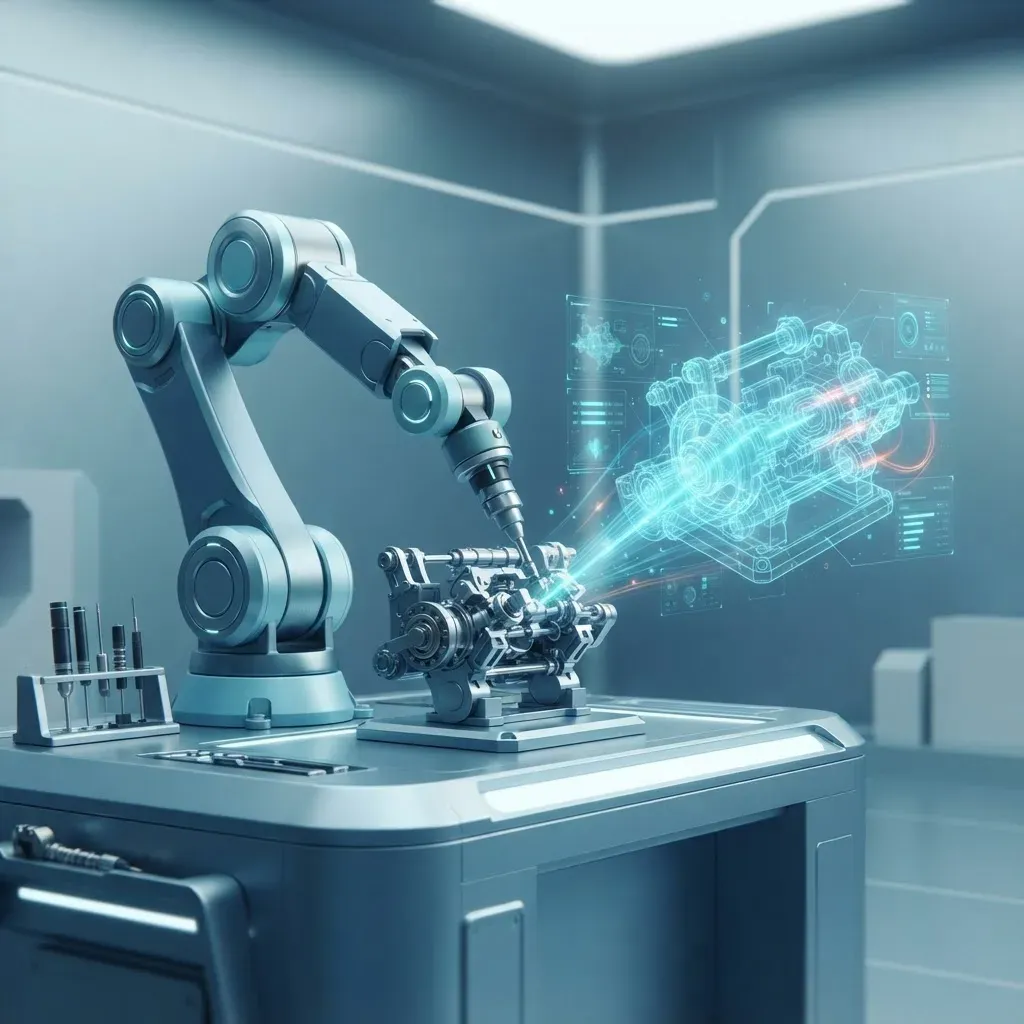
It is one of the most common questions in engineering circles today: will artificial intelligence replace mechanical engineers? The honest answer is nuanced. AI is already transforming how mechanical engineers work, automating specific tasks and accelerating design cycles, but the profession is not on a path to wholesale replacement. Instead, the role is evolving — and engineers who understand that evolution will thrive.
This article takes an evidence-based look at what AI can genuinely do in mechanical engineering, what it cannot, which tasks are most affected, and how engineers can position themselves for an AI-augmented future. The goal is neither hype nor fear, but a clear-eyed view you can act on.
Table of Contents
The short answer; What AI can already do in mechanical engineering; What AI cannot replace; Which tasks are changing the most; The rise of generative and simulation-driven design; Why judgment and accountability still need humans; How mechanical engineers can stay valuable; The realistic outlook for the profession; FAQs; Conclusion.
The Short Answer
No, AI is not going to replace mechanical engineers in any foreseeable timeframe — but it is going to change the job significantly. The engineers most at risk are those who define their value purely by tasks that AI does well: routine calculations, repetitive drafting, and standard analysis. The engineers who will flourish are those who lean into judgment, systems thinking, physical intuition, and the human responsibilities that AI cannot assume.
History supports this view. Every major tool in engineering — from the calculator to computer-aided design (CAD) to finite element analysis (FEA) — was predicted to reduce the need for engineers. Instead, each raised expectations, expanded what was possible, and shifted the work toward higher-level thinking. AI fits the same pattern, only faster and broader.
The realistic framing is augmentation, not replacement. AI becomes a powerful assistant that handles the tedious and the computational, freeing engineers to do more of the creative, strategic, and accountable work that defines the profession.
What AI Can Already Do in Mechanical Engineering
AI is genuinely capable in several areas. Generative design tools can produce hundreds of design candidates for a component given constraints like weight, material, and load, exploring a solution space far larger than a human could by hand. Simulation acceleration uses machine learning to approximate expensive physics calculations, giving engineers rapid feedback during early design.
AI also excels at pattern-heavy work: predictive maintenance that forecasts equipment failure from sensor data, quality inspection using computer vision, and optimization of parameters across complex systems. In documentation and knowledge work, AI assistants can draft reports, summarize standards, and help engineers navigate large technical corpora quickly.
These capabilities are real and growing, and they meaningfully boost productivity. An engineer using AI well can iterate faster, catch issues earlier, and spend less time on drudgery. Companies building these tools rely heavily on strong software foundations, from data pipelines to web applications that make advanced analysis accessible to engineering teams.
What AI Cannot Replace
For all its strengths, AI has fundamental limits in mechanical engineering. It lacks true physical intuition — the hard-won sense of how materials behave, how a mechanism will feel in the hand, or why a design that looks fine on screen will fail on the factory floor. AI recognizes patterns in data; it does not understand the physical world the way an experienced engineer does.
AI also cannot take accountability. When a bridge, an aircraft component, or a medical device fails, a licensed professional engineer bears legal and ethical responsibility. That accountability requires human judgment, professional ethics, and the ability to justify decisions to regulators, clients, and the public — none of which can be delegated to an algorithm.
Finally, AI struggles with novel, ambiguous, or cross-disciplinary problems where there is little precedent to learn from. Real engineering projects are full of messy trade-offs, incomplete requirements, and stakeholder negotiations. Navigating that ambiguity — deciding what problem to solve in the first place — remains distinctly human.
Which Tasks Are Changing the Most
The impact of AI is uneven across the mechanical engineer workflow. Routine tasks are changing fastest: repetitive drafting, standard stress calculations, first-pass component sizing, and boilerplate documentation are increasingly assisted or automated. Engineers spend less time producing these outputs and more time reviewing and refining them.
Design exploration is being transformed rather than eliminated. Generative tools do not remove the designer; they change the designer role from generating options to curating and validating them. The engineer sets constraints, interprets results, and makes the final call — a more strategic and arguably more demanding role.
Meanwhile, tasks requiring physical testing, cross-team coordination, manufacturing liaison, and client communication remain firmly human. Recognizing this distribution helps engineers focus their skill development where it matters most, rather than fearing blanket obsolescence.
The Rise of Generative and Simulation-Driven Design
Generative design deserves special attention because it represents the most visible AI shift in the field. By specifying goals and constraints, engineers can have algorithms generate optimized geometries — often organic, lattice-like structures that a human would never draw by hand but that perform superbly. This is powerful for lightweighting, additive manufacturing, and performance optimization.
Simulation-driven design pairs with this trend. Machine-learning surrogate models can approximate the results of computationally heavy simulations almost instantly, letting engineers explore many more design variations early in the process. The result is faster convergence on better designs and fewer costly late-stage surprises.
But these tools amplify the engineer rather than replace them. Someone must define the right constraints, judge which generated design is actually manufacturable and appropriate, and validate results against real-world behavior. Garbage constraints produce garbage designs, no matter how sophisticated the algorithm. Human expertise sets the boundaries within which AI creativity is useful.
Why Judgment and Accountability Still Need Humans
Engineering is ultimately about responsibility. Decisions affect safety, cost, the environment, and human lives, and society requires an accountable professional behind those decisions. Professional engineering licensure exists precisely because judgment and accountability cannot be automated away.
Consider a design trade-off between cost and a small increase in failure risk. An AI can quantify the probabilities, but deciding what level of risk is acceptable — weighing ethics, liability, regulation, and human impact — is a judgment call that belongs to a person. These decisions are contextual, values-laden, and consequential in ways that resist pure computation.
This is why the future belongs to engineers who use AI as a tool while retaining ownership of judgment. The professional who can leverage AI output and then critically evaluate, contextualize, and stand behind it is more valuable than ever, not less. Building the trustworthy software and secure data systems that support such work also depends on disciplined cybersecurity and reliable infrastructure.
How Mechanical Engineers Can Stay Valuable
The practical takeaway is to adapt deliberately. First, become fluent with AI tools in your domain — generative design, simulation, and AI-assisted analysis. Engineers who master these tools will outcompete those who ignore them, much as CAD-literate engineers outpaced those who clung to hand drafting.
Second, double down on the uniquely human skills: physical intuition, systems thinking, creativity, communication, and ethical judgment. Cultivate cross-disciplinary understanding, because the hardest and most valuable problems span mechanical, electrical, software, and business domains. Broad, integrative thinkers are hard to automate.
Third, invest in continuous learning and visibility. Share your expertise, build a portfolio, and stay current with emerging tools. Establishing a strong professional presence — even a well-crafted personal site built with clean website design — helps demonstrate the experience and expertise that set you apart in an AI-augmented market.
The Realistic Outlook for the Profession
The most credible forecasts describe transformation, not disappearance. Demand for mechanical engineering expertise remains strong across energy, mobility, robotics, healthcare, and manufacturing — fields where physical systems, safety, and innovation are central. AI raises productivity and expectations rather than removing the need for skilled professionals.
What will change is the composition of the work. Engineers will spend less time on rote computation and drafting and more on problem definition, design curation, validation, and cross-functional leadership. New roles will emerge at the intersection of engineering and AI, for those who can bridge both worlds.
In short, the profession is not ending; it is leveling up. The engineers who embrace AI as a collaborator, while owning the judgment and accountability that machines cannot, will find themselves more capable and more in demand than any previous generation.
Frequently Asked Questions
1. Will AI replace mechanical engineers entirely? No. AI is automating specific tasks and transforming workflows, but it cannot replace the physical intuition, judgment, and accountability at the core of engineering. The role is evolving toward higher-level thinking rather than disappearing.
2. Which mechanical engineering tasks are most affected by AI? Routine and repetitive tasks — standard calculations, first-pass drafting, boilerplate documentation, and design exploration — are changing fastest. Physical testing, cross-team coordination, and accountable decision-making remain firmly human.
3. Do I need to learn AI tools to stay competitive? Yes. Fluency with generative design, simulation acceleration, and AI-assisted analysis is becoming as essential as CAD literacy once was. Engineers who master these tools will outperform those who ignore them.
4. Why can't AI take responsibility for engineering decisions? Engineering decisions affect safety and lives, and society requires an accountable, often licensed professional behind them. Weighing ethics, liability, and risk is a human judgment that cannot be delegated to an algorithm.
5. What skills should mechanical engineers develop for the future? Focus on physical intuition, systems thinking, creativity, communication, ethical judgment, and cross-disciplinary knowledge, combined with fluency in AI tools. The ability to critically evaluate and stand behind AI output is especially valuable.
Conclusion
Will mechanical engineers be replaced by AI? The evidence points clearly to no — but the profession is being reshaped. AI is a powerful collaborator that automates the tedious and accelerates the computational, while the human core of engineering — intuition, judgment, creativity, and accountability — remains irreplaceable.
The engineers who thrive will treat AI as a tool to amplify their impact, master the new capabilities, and invest in the uniquely human skills that machines cannot replicate. Far from making engineers obsolete, AI is raising the ceiling on what a skilled engineer can achieve.
If you are building tools, portfolios, or platforms at the intersection of engineering and AI, our partners can help with tailored artificial intelligence and web applications solutions. Embrace the shift, own the judgment, and let AI make you a better engineer.